
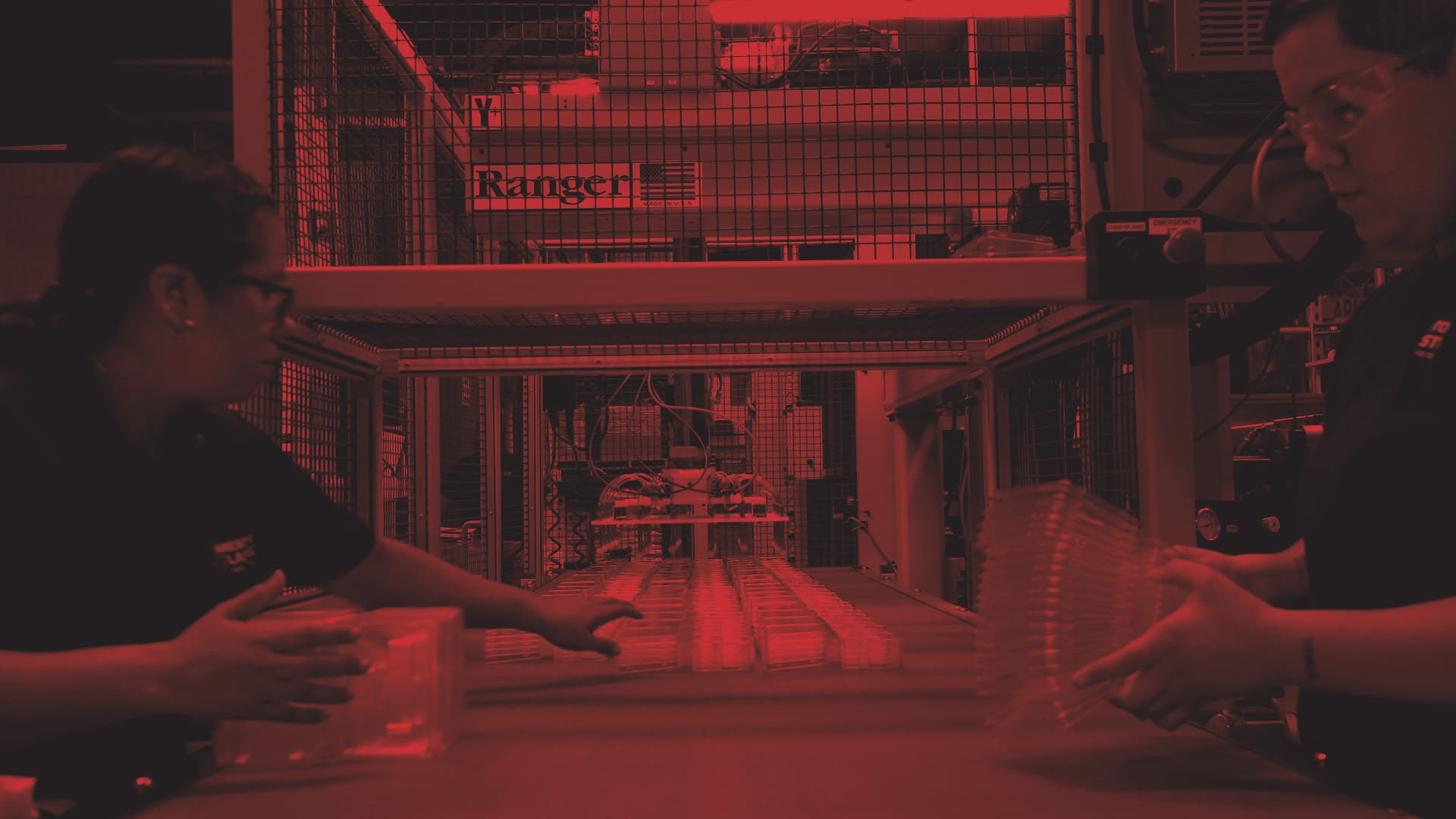
A thermoformed tray is created by heating plastic sheet and shaping it over a mold. The idea sounds simple; in practice, the right tray can improve part protection, cut waste, and support lean operations across an entire facility. Read on to see what thermoformed trays are, how they’re used, and how Jamestown Plastics approaches tray design across multiple markets.
What Is a Thermoformed Tray?
Every thermoformed tray starts as plastic sheet, either in flat sheet or roll form. The sheet is heated until pliable, then formed over a mold using a vacuum, pressure, or both. After cooling, the material holds the shape of the mold and is trimmed into its final form.
For manufacturers, the mold matters most. Pocket geometry, contours, and support features match the parts that will sit inside the tray, helping control orientation, reduce movement, and protect surfaces.
Common tray types include:
- Dunnage trays for transport and storage
- Insert trays used inside totes or cartons
- Medical device trays produced in cleanroom environments
- Assembly trays that move parts between operations
- Heavy-gauge trays designed for large or high-weight items
Thin-gauge trays work well for packaging, while heavy-gauge trays support demanding industrial settings.
How Thermoformed Trays Support Everyday Operations
A good tray affects more than storage. It influences speed, quality, and workflow.
Part Protection
Custom pockets reduce vibration, abrasion, and impact. Sensitive surfaces stay away from hard contact points, which is important for painted parts, polished components, circuit boards, and delicate assemblies.
Organization and Flow
Defined pockets help operators load and unload parts quickly. Trays can be built around specific part counts per layer or per tote, improving visual management and reducing handling time.
Consistency in Downstream Processes
When parts arrive in the same position every time, work moves faster. Trays designed for orientation support robotic loading, manual assembly, and inspection systems.
Cost and Waste Reduction
Reusable trays replace cardboard, foam, and other single-use materials. Over a full program, that shift often reduces packaging costs and helps remove waste from the plant floor. Lightweight plastic also supports efficient shipping.
Where Thermoformed Trays Are Used
Thermoformed trays appear across many industries because they can be tailored to nearly any part shape or workflow.
Automotive
Trays protect trim pieces, fasteners, electronic modules, and many other components. Returnable dunnage systems ride on racks or in trucks, supporting moves between stamping, molding, painting, and final assembly.
Medical
Device packaging, diagnostic components, and lab storage systems rely on trays produced in controlled environments. Cleanroom forming helps support strict quality requirements for sensitive products.
Electronics
Sensitive electronics need protection from both physical damage and static discharge. ESD and conductive materials help safeguard circuit boards, connectors, and sensors during handling and transport.
Consumer Goods
Insert trays organize retail sets, protect products during shipment, and create a clean presentation on store shelves. Cosmetic, tool, and hobby kits often use custom trays for this purpose.
General Industrial
Industrial manufacturers use trays for WIP storage, material handling, and delicate component transport. Custom tray and pallet systems can support lean initiatives and help standardize work across the floor.
Materials Used for Thermoformed Trays
Material selection affects strength, clarity, chemical resistance, and environmental goals. Jamestown Plastics works with a wide range of polymers to meet different requirements.
Common tray materials include:
- HIPS for cost-effective durability
- ABS for added toughness
- PETG, APET, and RPET for clear, formable, and often recyclable trays
- HDPE, MDPE, and LDPE for chemical resistance and flexibility
- Polycarbonate for impact resistance
- Polypropylene for fatigue strength and chemical performance
- ESD and anti-static materials for electronics
Material gauges from .005″ to .5″+ cover light-gauge packaging trays through heavy-gauge industrial systems. Sustainable options include recycled content, biodegradable materials, and durable reusable tray systems.
A Legacy of Designing and Manufacturing Thermoformed Trays
Jamestown Plastics brings more than 67 years of thermoforming experience to tray programs across automotive, medical, electronics, consumer goods, and industrial markets.
In-House Engineering and Tooling
Design and tooling stay in-house, giving engineers direct control over part fit, draft, stacking features, and structural details. This approach helps create trays that perform well in real operations, not just on paper.
Cleanroom Production and Advanced Equipment
ISO Class 7 and 8 cleanrooms support medical and contamination-sensitive applications. High-speed in-line machines, heavy-gauge sheet forming, and robotic trimming help handle a wide range of sizes and production volumes.
Attention to Practical Details
Effective trays consider more than pocket geometry. Jamestown Plastics reviews how the tray will be handled, how it nests or stacks, how it interfaces with racks and totes, and how materials support sustainability and regulatory goals.
Multi-Location, Made in the USA Manufacturing
Facilities in New York, Texas, and Pennsylvania provide redundant capacity and logistical flexibility. All products are 100% Made in the USA.
When a Custom Tray Makes Sense
A custom thermoformed tray is often the right choice when parts arrive damaged, shift inside their packaging, or require extra protection. It also helps when programs need better packing density, new automation, or improved workflow consistency.
Partner With Jamestown Plastics
Thermoformed trays play a central role in protecting parts and supporting efficient operations. Jamestown Plastics designs and manufactures trays built for strength, repeatability, and long-term value across multiple industries.
Ready to discuss a custom thermoformed tray for your application? Contact Jamestown Plastics today.